
2-2-5-5 calendar template
Two fixed weekday nights for each parent every week, then five-night blocks that carry the weekend back and forth between the homes.
Reviewed by SupportDecode Editorial Team Page content reviewed Sources Methodology Update log
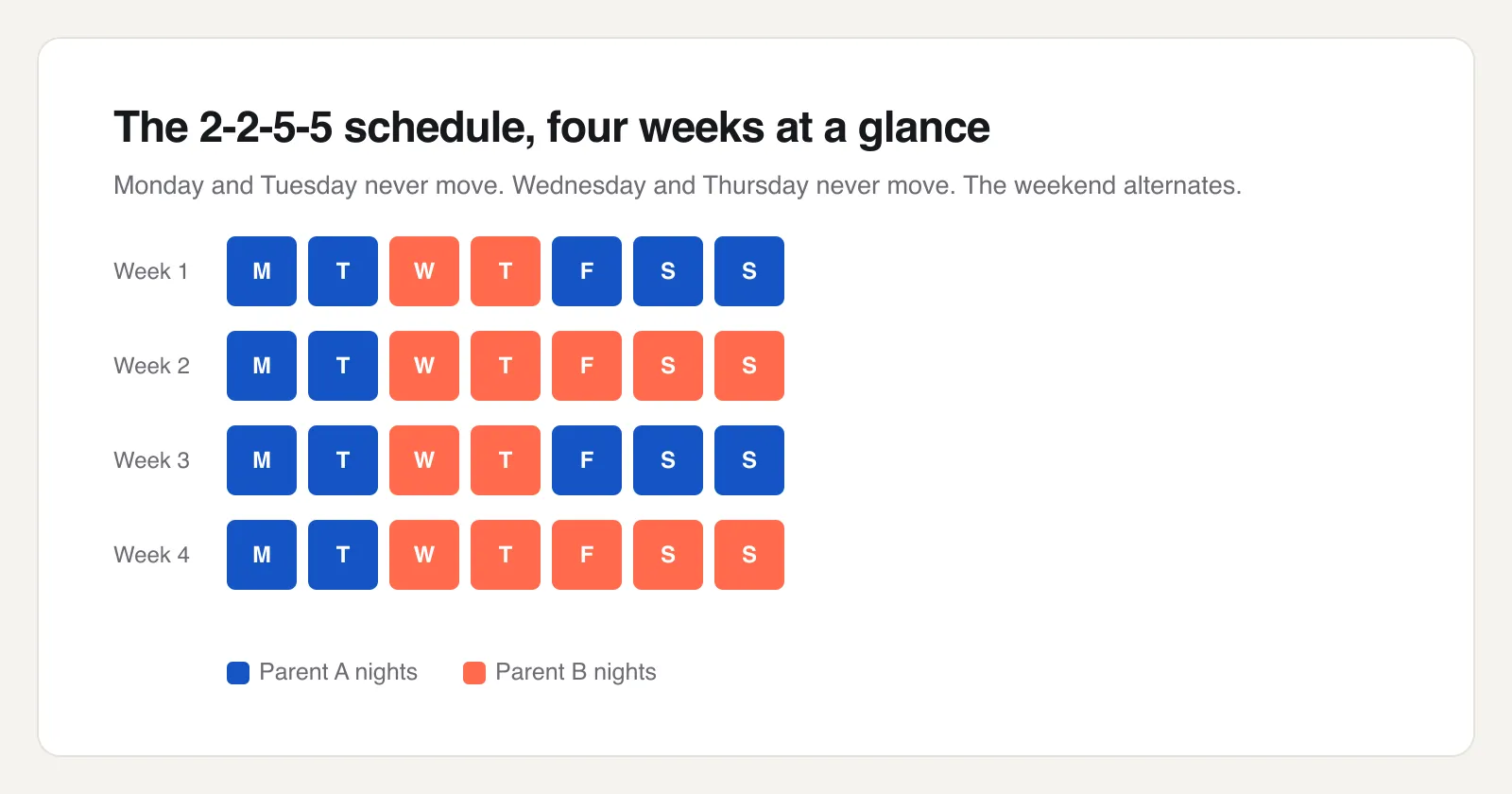
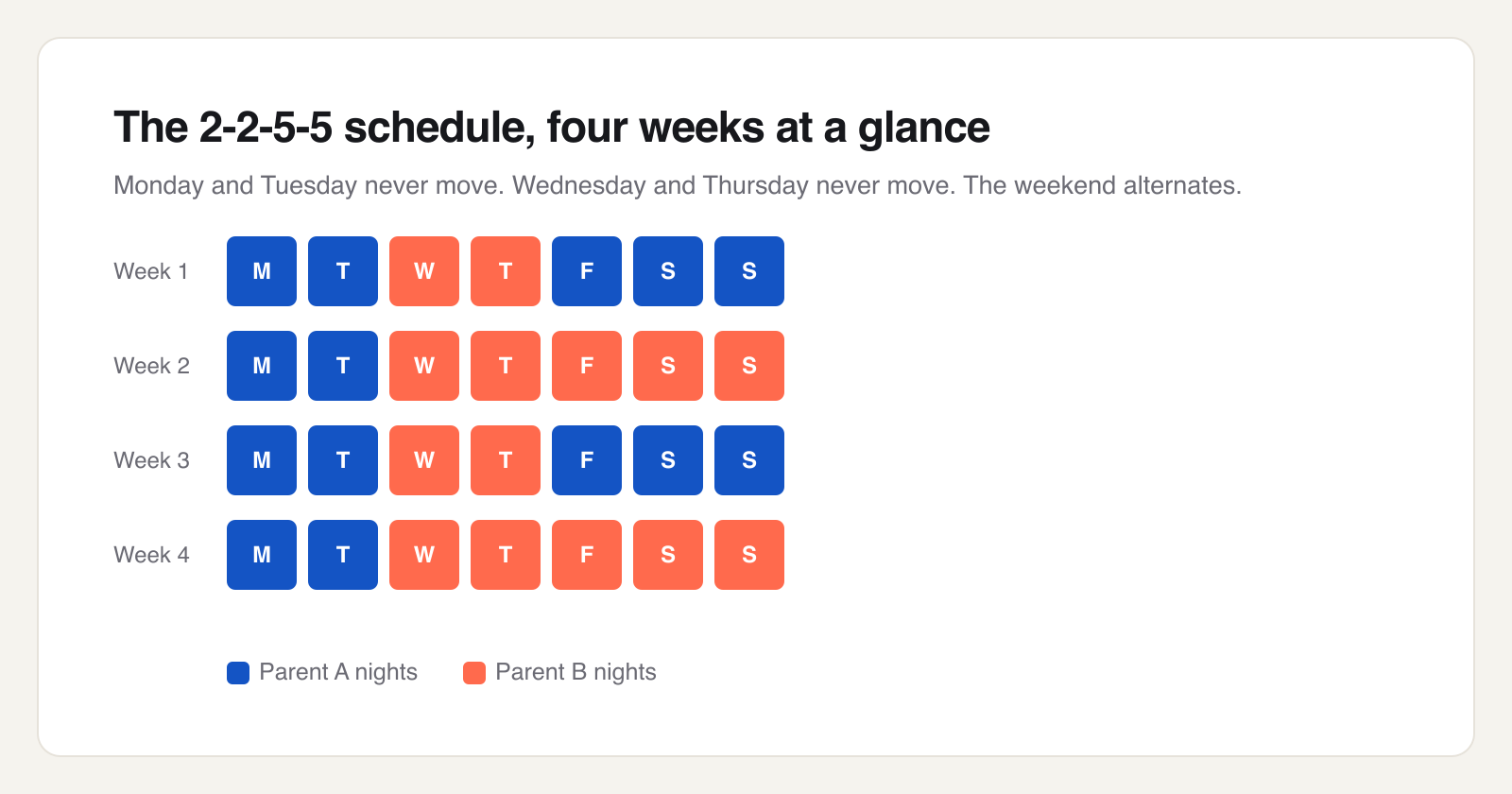
2-2-5-5 visual calendar: four weeks at a glance
Parent A keeps Monday and Tuesday, Parent B keeps Wednesday and Thursday, and the Friday-through-Sunday weekend alternates. The four-week view repeats the same two-week cycle twice so the fixed weekdays are easy to verify.
The repeating cycle, day by day
| Week | Mon | Tue | Wed | Thu | Fri | Sat | Sun |
|---|---|---|---|---|---|---|---|
| Week 1 | Day 1A | Day 2A | Day 3B | Day 4B | Day 5A | Day 6A | Day 7A |
| Week 2 | Day 8A | Day 9A | Day 10B | Day 11B | Day 12B | Day 13B | Day 14B |
This pattern is commonly described as a 50/50 split. That figure comes from counting the overnights in the cycle above. It is the pattern's own arithmetic, not a legal standard, and no state requires this or any other rotation.
How overnight counts connect to child support
A 50/50 schedule does not produce the same support result in every state. Florida's guideline uses a shared-parenting method when each parent has at least 73 overnights a year, so the actual calendar count matters. Texas does not automatically change its percentage guideline for a particular number of overnights, although the court may consider possession time when deciding whether to vary from the guideline.
Reading the 2-2-5-5 cycle
The fortnight opens like 2-2-3: parent A has two nights, then parent B has two. From there it diverges. Instead of a short weekend block, each parent takes a full five-night run, first A, then B.
Anchored to a Monday, the layout settles into a tidy shape. Parent A owns Monday and Tuesday every week. Parent B owns Wednesday and Thursday every week. The Friday-to-Sunday stretch attaches to whichever five-night run is underway, so weekends alternate on their own.
Each parent ends up with 7 of the 14 overnights. The division is genuinely equal, and it gets there with only four changeovers per cycle.
The five-night block is both the feature and the test. A child who handles five nights away from a parent gains a settled stretch of routine in each home. A child who cannot yet is usually better served by one of the shorter rhythms.
The families 2-2-5-5 was built for
Think of it as the school-age upgrade path from 2-2-3. The weekday anchors stay put, so the child always knows where a given school night happens, and each parent can commit to standing obligations on the other parent’s fixed nights.
The pattern rewards parents whose work weeks differ. One parent with early-week shifts and one with late-week shifts can each cover their own pair without childcare, then trade the longer blocks around the weekend.
The wait at the far end of each block deserves planning. From the Wednesday handoff, five nights pass before the child is back with parent A. Many plans soften this with a standing phone or video call in the middle of every long block.
When this pattern tends to fit
- School-age children who manage five nights away comfortably
- Parents with fixed, complementary work schedules
- Families who want alternating weekends without extra trades
Honest downsides
- Five-night gaps are long for toddlers and preschoolers
- The mid-block wait can be hard on a parent, not just the child
- The symmetry breaks quickly if one parent travels for work
How 2-2-5-5 schedule compares
The patterns below split overnights in similar proportions, so choosing between them mostly comes down to two numbers: how often the child changes homes, and how long each stay runs. Every figure is counted from the repeating cycles themselves.
| Pattern | Cycle | Overnights | Exchanges per cycle | Longest stay in one home |
|---|---|---|---|---|
| 2-2-3 schedule | 14 nights | 7 / 7 | 6 | 3 nights |
| 3-4-4-3 schedule | 14 nights | 7 / 7 | 4 | 4 nights |
| 2-2-5-5 schedule (this page) | 14 nights | 7 / 7 | 4 | 5 nights |
| Week on / week off | 14 nights | 7 / 7 | 2 | 7 nights |
Overnights over a year
Arithmetic check: 2 plus 2 plus 5 plus 5 is 14, split 7 and 7. Twenty-six turns of the wheel cover 364 nights, 182 per parent, before the year’s extra night lands.
Changeovers: four per cycle. Longest gap: five nights, reached twice per fortnight.
See it on real dates
Open the custody schedule generator with the 2-2-5-5 schedule preselected to lay the cycle over an actual calendar from any anchor date and download it as a free .ics file for any calendar app. To turn the rotation into a yearly overnight count for a support formula, use the parenting time calculator.
2-2-5-5 schedule FAQs
Is 2-2-5-5 the same as 5-5-2-2?
It is the same wheel started at a different point. Rotate the cycle and the blocks line up exactly, so plans written either way produce identical calendars once they run. What matters in practice is which weekday the plan anchors to and who takes the opening pair.
How do weekends fall in a 2-2-5-5 schedule?
They alternate automatically. Each five-night block spans a Friday, Saturday, and Sunday, and the blocks trade off between the parents, so neither household needs a separate weekend rotation layered on top.
What is the longest time the child spends away from each parent?
Five nights, once per parent per cycle, during the other household’s long block. Compare that with three nights under 2-2-3 and seven under week on week off; 2-2-5-5 is the middle step between them.
How many overnights does each parent get per year under 2-2-5-5?
Half of them. Across 365 nights the rotation deals each parent about 182, and the one night that will not divide evenly simply falls to whoever’s block contains it.
Does 2-2-5-5 have to start on a Monday?
No. The anchor day is a choice, not a rule. Families often anchor the cycle so each parent’s fixed pair covers the evenings the other parent works late, which lets the template absorb two work schedules at once.
About the numbers on this page
Custody schedule patterns are scheduling conventions used by families, mediators, and courts. They are not law. No statute mandates any rotation on this page, and no agency publishes an official version of them, so this page cites no statutes. Every count and percentage above comes from the pattern's own cycle, which you can verify against the day-by-day table. For how a state's support formula treats parenting time, see that state's page on this site.
Reviewed by SupportDecode Editorial Team Page content reviewed Sources Methodology Update log
Changelog: page content reviewed as part of the custody schedule library. Material changes are dated in the update log.